AI Landscape Design: Redesign Your Front Yard or Backyard From a Photo
See new lawn, planting beds, paths and climate-appropriate plants on a photo of your own yard before you dig. How to photograph the yard, which layout rules hold up, and how to pick plants that will survive where you live.
Hoceine
8 min read18 views
In this article
- What can AI landscape design show me?
- How do I photograph my yard for an AI redesign?
- How do I redesign my yard with AI?
- How deep should planting beds be?
- How wide should a garden path be?
- How do I choose plants that suit my climate?
- Should I keep my lawn?
- What does a front yard redesign usually include?
- Can I use these images in a real estate listing?
- Try it on your own yard
- Frequently asked questions
A bare front yard with a strip of lawn and a few tired shrubs along the foundation is one of the most common sights in any suburb. Most people know it could look better. Fewer know where to start: what goes where, how wide the beds should be, and which plants won't die in the first summer. A landscape designer can answer all of that, but many homeowners want to see a direction first. A photo of your own yard is enough to start.
Short answer: photograph your yard from the street or the back door, upload it to the AI room designer with the Garden or Patio room type (or House exterior for the front), and try a few garden styles. Use the Landscaping photo fix to add designed beds, layered shrubs, perennials, mulch and clean edges, or Green lawn to fix patchy grass. Then check every plant against your climate zone before buying.
What can AI landscape design show me?
| Element | How well a photo preview works | What to check in real life |
|---|---|---|
| Planting beds and their shape | Very well | Bed depth, sun and drainage |
| Lawn vs no lawn | Very well | Water use, maintenance time |
| Paths and stepping stones | Well | Width, slope, materials |
| Shrub and perennial layering | Well | Mature size of real plants |
| Patio and seating areas | Well | Drainage, permits for large hardscape |
| Garden style (English, Japanese, desert, formal, wild) | Very well | Climate fit |
| Exact plant species | Poorly | Confirm with a local nursery |
| Grading, retaining walls, drainage | Concept only | Landscape contractor or engineer |
The images are a design direction. Plants in the render may not be the exact species you'd buy, so treat them as "a mounded evergreen shrub about this size" and choose the real plant locally.
How do I photograph my yard for an AI redesign?
- For a front yard, stand across the street or at the end of the driveway so the house and yard are both in frame.
- For a backyard, stand at the back door or a top-floor window. A slightly higher angle shows the layout better.
- Hold the phone level at chest height and use the 1x lens.
- Shoot on a bright, overcast day so shadows don't hide the ground.
- Take one wide shot and one closer shot of the area you want to change most.
- Move toys, hoses and bins out of the frame.
How do I redesign my yard with AI?
- Upload the photo to the AI room designer. Choose Garden or Patio for a backyard, or House exterior for the front.
- Pick a garden style. Options include English Garden, Japanese Garden, Desert Garden, Formal Garden and Wild Garden, alongside general styles like Mediterranean, Coastal and Modern.
- Add a note about your climate and needs. For example: "low-water plants for a hot dry summer, keep the existing path, small lawn for a dog."
- Use photo fixes for quick improvements. In the results, tap Landscaping for designed beds with layered shrubs, flowering perennials suited to the climate, fresh mulch and defined edges, keeping hardscape where it is. Tap Green lawn to see the yard with healthy grass, or Summer refresh to turn a winter photo green.
- Refine with Magic Edit. Brush over a single area and restyle it: "replace this lawn strip with a gravel path and lavender," or erase an old shrub.
Each generation or fix costs one credit. New accounts start with free credits.
How deep should planting beds be?
Shallow beds are the most common mistake in front yards. A one-foot strip of shrubs against the house looks thin. Deeper beds let you layer plants by height.
| Location | Recommended bed depth | Layout |
|---|---|---|
| Foundation bed, single-story house | 4-6 ft | Shrubs at back, perennials middle, low edging plants front |
| Foundation bed, two-story house | 6-8 ft | Taller shrubs or small trees at corners |
| Border along a fence | 4-8 ft | Tall at back, medium, low at front |
| Island bed in lawn | Width at least 1/3 of its length | Tallest in the center |
| Path edging | 18-36 in | Low plants that won't flop onto the path |
Leave space between shrubs and the house wall (about 2-3 ft for most shrubs) so you can maintain the siding and air can circulate.
How wide should a garden path be?
| Path type | Width |
|---|---|
| Main front walkway | 4-5 ft (two people side by side) |
| Secondary path | 3 ft |
| Stepping-stone path | Stones 18-24 in across, about 24 in center to center |
| Wheelchair or stroller access | At least 3-4 ft, firm and level |
Curved paths look relaxed, but they should still lead where people want to go. If the curve adds a long detour, people will cut across the lawn.
How do I choose plants that suit my climate?
This is the step AI can't do for you, and it's the one that decides whether the garden survives.
- Find your hardiness zone. In the US, the USDA Plant Hardiness Zone Map gives your zone by ZIP code. In the UK, the RHS hardiness ratings play a similar role. Other countries have their own systems.
- Note sun exposure. Full sun (6+ hours of direct sun), part shade (3-6 hours) or shade (under 3). Watch your yard for a day, or use a sun-tracking app.
- Check soil and drainage. Dig a hole, fill it with water and see how long it takes to drain. Many plants fail because of wet roots, not cold.
- Favor native and regionally adapted plants. They usually need less water and support local pollinators. Local extension services, native plant societies and independent nurseries are the best sources.
- Plant for mature size. Space shrubs by their mature width, not their pot size. Young beds look sparse for a season or two, so fill gaps with mulch or annuals.
- Plant in groups. Groups of three, five or seven of the same plant look more designed than one of everything.
- Mulch 2-3 inches deep, keeping it a few inches away from stems and trunks.
Should I keep my lawn?
Lawns are good for play and pets but need regular water, mowing and feeding. In dry climates, many homeowners shrink the lawn to a usable patch and replace the rest with planting beds, gravel gardens or drought-tolerant groundcovers. Some cities and water utilities offer rebates for replacing turf, so check locally.
| Option | Water use | Maintenance | Good for |
|---|---|---|---|
| Traditional lawn | High | Weekly mowing in season | Kids, pets, cool and wet climates |
| Smaller lawn plus beds | Medium | Moderate | Most suburban yards |
| Gravel garden with drought-tolerant plants | Low | Low once established | Hot, dry climates |
| Native meadow or wild garden | Low | Annual cut back | Larger yards, wildlife |
| Groundcover instead of grass | Low to medium | Low | Shady areas, slopes |
What does a front yard redesign usually include?
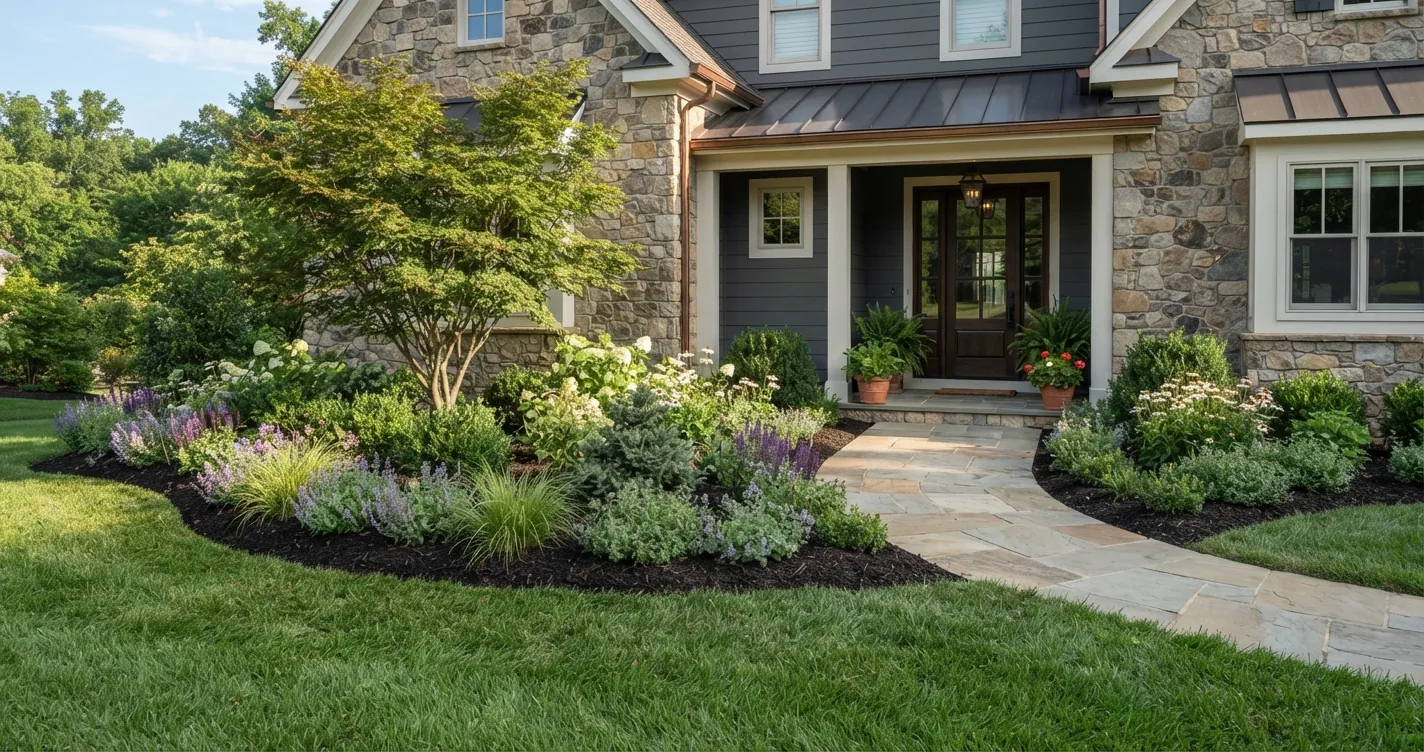
The most visible improvements are often simple: deeper foundation beds with layered planting, a clean edge between lawn and beds, fresh mulch, a wider front path, planters at the door and a couple of well-placed small trees. That's roughly what the Landscaping photo fix shows. For more front-of-house ideas, including paint and the entry, see AI exterior house design.
For evening atmosphere in the backyard, our guide on how to hang patio string lights and the string lights calculator cover lighting.
Can I use these images in a real estate listing?
If you're selling, AI landscaping images can help buyers picture the yard's potential, but they must be labeled as concepts and not presented as the current state. The Green lawn fix on a listing photo is a cosmetic edit only when the lawn will actually look that way at showings. Follow your MLS rules on disclosure. See AI sky replacement for real estate photos for how those rules usually work.
Try it on your own yard
Take one photo of the front yard and one of the back, upload them, and compare a couple of garden styles plus the Landscaping fix. It's a quick way to decide what you want before calling a landscaper or heading to the nursery, and the free credits you get on signup cover a first try.
Frequently asked questions
Can AI design my landscaping from a photo?
Yes. AI tools can redesign a photo of your yard with new beds, lawn, paths and planting in different garden styles, while keeping your house and hardscape in place.
How deep should a front yard flower bed be?
About 4-6 feet for a single-story house and 6-8 feet for a two-story house, so you can layer shrubs, perennials and low edging plants.
How do I know which plants will grow in my yard?
Check your hardiness zone (the USDA map in the US), note how many hours of sun each area gets, test drainage, and ask a local nursery or extension service for regionally adapted plants.
How wide should a front walkway be?
About 4-5 feet so two people can walk side by side. Secondary paths can be 3 feet.
Is AI landscape design accurate about plants?
It's accurate about layout, scale and style. The plants shown are representative, so confirm actual species for your climate before buying.