Best Paint Colors for Dark Rooms: Go Light or Go Moody?
White paint in a room with no windows often turns gray and flat. Here's how to choose between a high-LRV light color and a deliberately dark one, plus the bulbs and sheen that make either work.
Hoceine
8 min read16 views
In this article
- Why does white paint look gray in a dark room?
- Should I paint a dark room light or dark?
- Which undertones work in a north-facing or windowless room?
- What light bulbs make paint look right in a dark room?
- What paint finish should I use in a dark room?
- How do I test colors before buying a gallon?
- Other ways to brighten a room with no windows
- Frequently asked questions
A thread on r/interiordecorating titled "Advice for windowless bedroom" asked what most people with a dim room eventually ask: should I paint it white to make it brighter, or give up and go dark? In another thread, someone with a 10x10 home office and no windows wanted to know if painting it black was a bad idea. Both instincts can work, depending on the room.
Short answer: in a room with little or no daylight, plain white usually reads as dull gray. If you want light, pick a warm white or pale color with an LRV of about 75 or higher and fix the lighting with 2700-3000K bulbs rated CRI 90+. If the room is small or used mostly at night, a deep color under LRV 15 in eggshell can look intentional and cozy.
Why does white paint look gray in a dark room?
Paint doesn't make light. It only reflects what reaches it. A white wall in a dim room is reflecting very little, so your eye reads it as a pale gray, often a slightly dirty one. The corners, where light falls off fastest, look darkest of all. That's why people paint a north-facing bedroom bright white and then say it feels like a waiting room.
The number to know is LRV, or light reflectance value. It runs from 0 (absolute black) to 100 (perfect white), and most paint brands print it on the swatch or the product page. It tells you what share of visible light the color bounces back.
| LRV range | What it looks like in a dim room | Good for |
|---|---|---|
| 85-94 | Bright whites. Can look stark or blue if the bulbs are cool | Ceilings, rooms with some daylight |
| 75-84 | Soft warm whites and creams. Usually the best "light" choice | Windowless bedrooms, hallways, north rooms |
| 55-74 | Light greige, pale sage, light clay | Rooms where you want color without darkness |
| 30-54 | Mid tones. Often look muddy with poor light | Avoid in very dark rooms unless lighting is strong |
| 15-29 | Rich colors that still show their hue | Accent walls, dining rooms |
| Under 15 | Deep navy, charcoal, forest green, near-black | Small rooms, offices, bedrooms used at night |
The middle band is the one to be careful with. A color around LRV 40 is neither bright enough to bounce light nor dark enough to feel like a choice. In a room with no windows it tends to look tired.
Should I paint a dark room light or dark?
Ask two questions: how big is the room, and when do you use it?
Go light if the room is a hallway, bathroom or a space you use during the day, and if you plan to add decent lighting. A pale warm color with an LRV in the high 70s or low 80s will spread lamp light further than a deep one. It won't make a windowless room feel sunny, but it keeps it from feeling closed in.
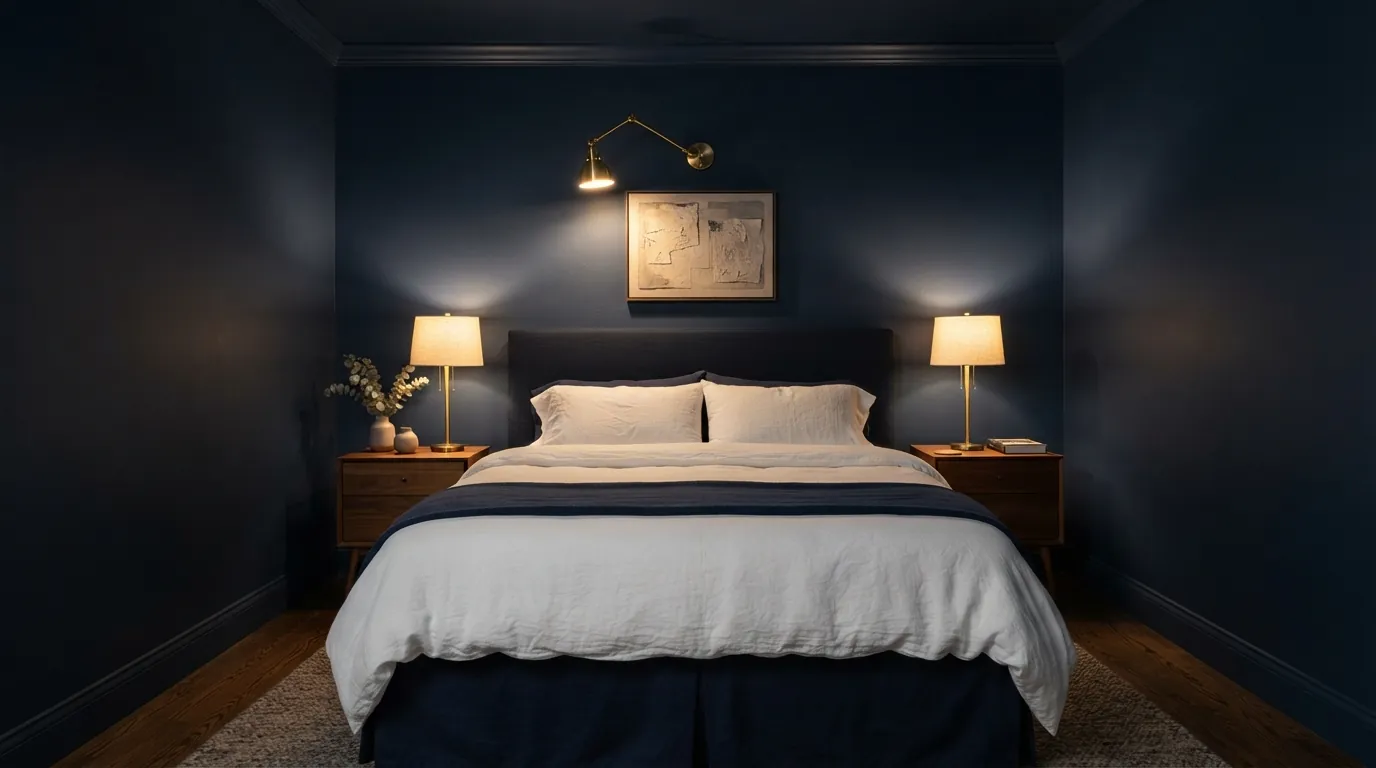
Go dark if the room is small, used mainly in the evening (a bedroom, a media room, a study), or already has character like paneling or molding. Designers call this "leaning in." Once the walls are deep enough, the corners stop looking like shadows because the whole room is one tone. Edges blur and the space can feel wrapped and calm.
The color-drenching approach makes dark colors work better. Paint the walls, trim and sometimes the ceiling in the same color or close shades of it. A dark wall next to bright white trim creates hard contrast lines that make a small room look choppy.
Which undertones work in a north-facing or windowless room?
North light (in the northern hemisphere) is cool and indirect. It pulls colors toward blue and gray. A room with no windows has no daylight at all, so your bulbs decide everything.
- For north-facing rooms, pick colors with warm undertones: whites with a hint of yellow or red, greiges that lean beige, greens with yellow in them, terracotta and clay.
- Avoid cool grays and blue-based whites unless you like a crisp, slightly cold look. They usually read as gloomy in this light.
- For windowless rooms, test every sample under the exact bulbs you'll use. A swatch that looks perfect at the paint store may turn green or pink at home.
Deep colors that hold up well in low light include navy with a touch of red in it, deep green, aubergine, chocolate brown and warm charcoal. Pure black can work, but soft blacks with a brown or green base are easier to live with.
What light bulbs make paint look right in a dark room?
This matters more than the paint. Two numbers on the bulb box:
| Bulb spec | What to buy | Why |
|---|---|---|
| Color temperature | 2700K for bedrooms and living spaces, 3000K for kitchens, baths and offices | Warmer light flatters most paint colors and skin tones |
| CRI (color rendering index) | 90 or higher | Low-CRI bulbs make colors look flat or off |
| Brightness | Roughly 10-20 lumens per square foot for general light | A 10x12 room needs about 1,200-2,400 lumens total |
| Placement | At least three sources at different heights | One ceiling light leaves corners dark |
Our light color temperature calculator will help you pick a Kelvin value per room, and the lighting calculator estimates how many lumens you need.
If the room has any window at all, the sun path room simulator shows when direct light actually reaches it during the day. Plenty of rooms people call "dark" get an hour of sun at a time they're never home.
What paint finish should I use in a dark room?
Eggshell is the safe default for walls. It has enough sheen to bounce a little light and wipe clean, without the glare and roller marks that satin and semi-gloss show on imperfect walls. Flat or matte is lovely with deep colors because it looks velvety, but it marks easily, so save it for bedrooms and low-traffic rooms.
| Finish | Sheen | Best use in a dark room |
|---|---|---|
| Flat / matte | Lowest | Deep colors in bedrooms, ceilings |
| Eggshell | Low | Most walls, light or dark |
| Satin | Medium | Bathrooms, kids' rooms, trim when color-drenching |
| Semi-gloss | High | Trim and doors in a light scheme |
| High gloss | Highest | Lacquered statement walls (needs very smooth walls) |
The paint sheen selector walks through the trade-offs if you're unsure.
How do I test colors before buying a gallon?
Paint two large samples, at least 2x2 feet, on different walls. Look at them at the time of day you use the room most, with your real bulbs switched on. Small chips on a single wall almost always mislead you in a dark room because the color shifts from corner to corner.
You can also skip a round of sample pots by previewing colors on a photo first. Take a picture of the room with the lights on as you normally use them, upload it to the AI room painter, and try a warm white, a pale sage and a deep navy side by side. Narrow it down to two, then buy samples of only those. It saves money and stops you from repainting a wall three times. New accounts get a few free credits, so you can try it on your own room before deciding anything.
For more on choosing color in general, see how to choose a paint color for your living room and the best neutral paint colors.
Other ways to brighten a room with no windows
Paint is one lever. These help too:
- A large mirror opposite your main lamp spreads light around. It won't replace a window, but it helps.
- Light flooring or a big pale rug reflects light upward. A dark floor and dark walls together can be too much unless you want a full cocoon.
- Wall sconces and uplights wash the walls with light and remove the "cave" feeling more than any ceiling fixture does.
- A white or very pale ceiling in a light scheme, with an LRV above 85.
- Warm LED strips hidden behind a headboard, on top of a wardrobe or under shelves.
Frequently asked questions
What color makes a dark room look brighter?
A warm white or pale neutral with an LRV around 75-85, combined with 2700-3000K bulbs that have a CRI of 90 or higher. Bright cool whites often look gray without daylight.
Is it a bad idea to paint a small dark room a dark color?
Usually not. Small rooms used in the evening often look better in a deep color under LRV 15, especially if you paint the trim and walls in the same shade. The room feels deliberate instead of dim.
What is a good LRV for a room with no natural light?
For a light look, choose LRV 75 or higher. For a moody look, go below 15. The range between about 30 and 55 tends to look muddy in rooms without daylight.
What paint colors should you avoid in a north-facing room?
Cool grays and whites with blue or green undertones. North light already pushes colors cooler, so those can look cold and dreary.
Does paint sheen make a dark room brighter?
Slightly. Eggshell and satin reflect more light than matte, but the difference is small. Better bulbs and more light sources change a dark room far more than a shinier finish.