Feng Shui Front Door and Entryway: Colors, Layout and What to Avoid
The front door sets the tone for your whole home. Here is how to choose a front door color that suits your house, set up a bright, uncluttered entryway, and fix common layout problems.
Hoceine
9 min read146 views
In this article
Feng shui gives the front door as much attention as the bedroom and the desk. It's the first thing visitors see, the place you pass through every day, and the space that sets the mood for the rest of the house.
The principles are refreshingly practical. A door that's easy to find, opens fully, and leads into a clear, bright entry is good feng shui, and it's also good design. Most fixes for an awkward entry are simple: better lighting, a rug, proper storage or a well-placed plant.
Quick answer: Keep the path to your front door clear and well lit, make sure the door opens fully without hitting clutter, and keep the hardware, house numbers and doorbell in good repair. Choose a door color that suits your house: look at the brick, siding, roof and trim, then pick a color that either contrasts clearly or deepens one of those tones. Inside, add closed storage for shoes, layered light, and hang any mirror on a side wall rather than straight opposite the door.
Choosing a Front Door Color
A good door color does three jobs. It suits the architecture, it stands out enough that visitors find the entrance, and it holds up to sun and weather.
Start with what you can't change
Look at the fixed materials first: roof, brick or stone, siding, window frames and trim. Your door should work with those, not fight them. Hold paint samples against the house in daylight, not against a white wall indoors.
Front door colors by house style
| House style | Colors that work | Why |
|---|---|---|
| Red or brown brick | Navy, deep green, black, warm white | Cool or dark tones contrast cleanly with warm brick |
| White or light siding | Red, black, navy, teal, mustard | Almost any saturated color reads well against white |
| Gray siding | Yellow, red, coral, natural wood | Warm colors stop a gray facade looking flat |
| Stone or stucco | Natural wood, olive, terracotta, charcoal | Earthy tones echo the texture of the walls |
| Modern, minimal exterior | Black, charcoal, natural oak, bold orange | A single strong door suits clean lines |
| Farmhouse or cottage | Sage, soft blue, barn red, cream | Muted, slightly dusty tones match the style |
| Traditional or colonial | Black, navy, deep red, forest green | Classic, high-gloss colors suit formal facades |
Contrast and visibility
The door should be the most obvious opening on the front of the house. If it's the same color as the walls, visitors hesitate, and the house looks closed off from the street. A door one or two shades darker or brighter than the trim is usually enough. Black and navy are safe choices; red, yellow and teal make a stronger statement.
What about a red front door?
Red is one of the most popular door colors for good reasons. It shows up from the street, it suits white, gray and stone exteriors, and a deep brick or oxblood red looks classic on traditional houses. It clashes with orange-toned brick, and bright red fades faster in strong sun, so choose a deeper shade and a UV-resistant exterior paint if your door gets afternoon light.
Finish and maintenance
- Use exterior paint in semi-gloss or high-gloss. It wipes clean and resists moisture.
- Dark colors absorb heat. On a south- or west-facing door in a hot climate, a black or navy door can get hot enough to warp some materials. Check your door manufacturer's guidance.
- Repaint every few years. Faded or peeling paint is the first thing visitors notice.
- Match the hardware to the color. Brass and gold warm up navy and green, black hardware sharpens white and gray, and brushed nickel suits modern exteriors.
- Bring in color without painting if HOA rules or a historic facade limit you: a doormat, a pair of planters or new hardware can do a lot.
For a deeper look at how colors balance across a home, see our feng shui colors guide. To preview a color on your own walls, try the room painter.
The Approach: Outside the Door
Think about how a first-time visitor reaches your door, and start from the street.
Do
- Make the door easy to see. Trim overgrown shrubs, light the path, and make sure the door is clearly the main entrance.
- Keep the path gently curving if you can. A long, straight path can feel like a runway. Planters along the edges break it up.
- Use a pair of healthy plants to frame the door. Pairs look balanced and welcoming. Our feng shui plants guide lists good porch options.
- Keep house numbers large, clear and lit. Delivery drivers and guests will thank you.
- Fix squeaks, sticking locks and broken doorbells. A door that sticks or rattles is a daily irritation and makes the house look neglected.
Don't
- Leave trash bins, recycling or broken items next to the door.
- Let a tree, pole or the corner of a neighboring building dominate the view of the door if you can soften it. A plant, a light or a small screen helps.
- Use a worn or dirty doormat. A fresh, generous doormat is the cheapest upgrade there is.
Inside the Entryway
The entryway is where you drop keys, shoes and bags, so the goal is a space that feels open, bright and calm and stays that way.
Entryway essentials
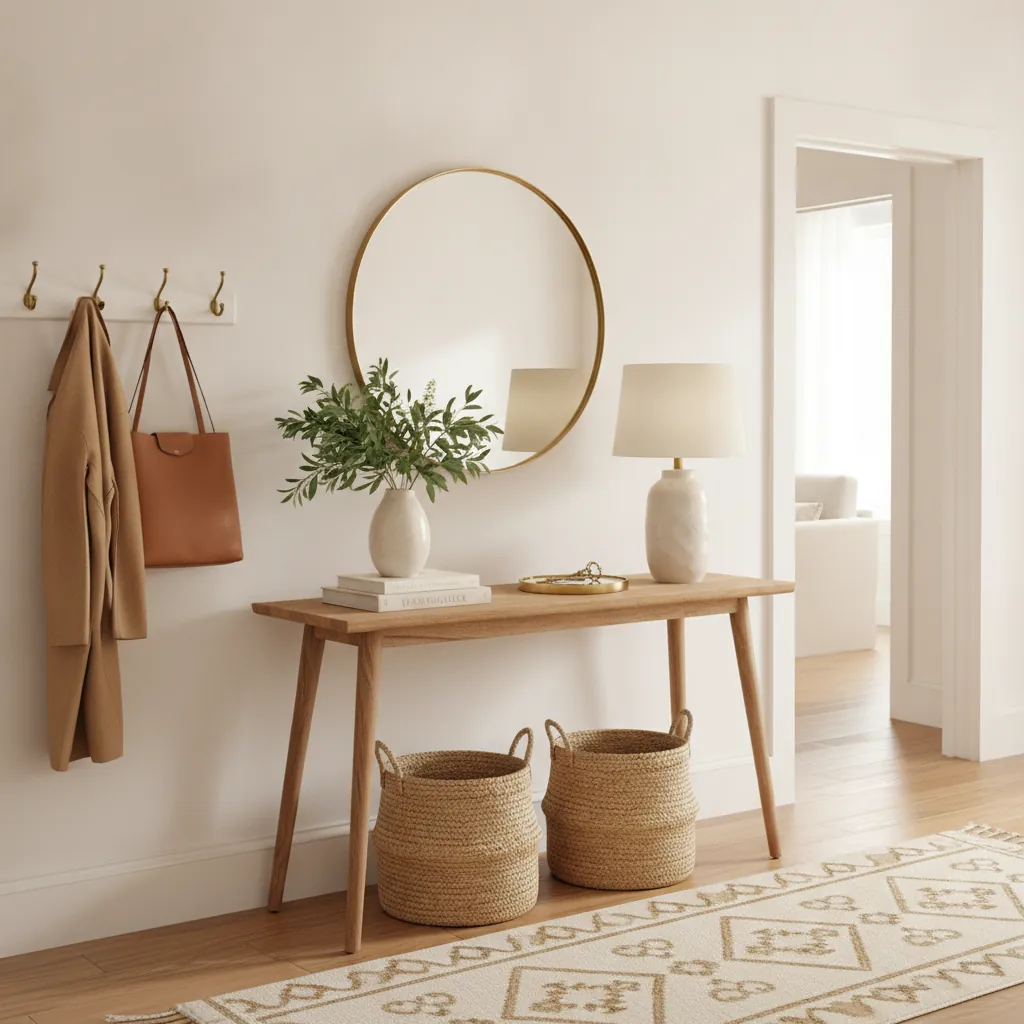
- Good lighting. A dark entry is one of the most common problems and one of the easiest to fix. A ceiling light plus a lamp on a console works well, and a motion-sensor light helps when you come home with full hands.
- A door that opens fully. Nothing stored behind it: no coat piles, shoe racks or boxes blocking its swing.
- Closed storage for shoes and bags. A shoe cabinet, a bench with baskets underneath, or a narrow cupboard keeps piles out of sight.
- Hooks at two heights if you have children, so their coats don't end up on the floor.
- A rug that catches dirt and softens footsteps, especially in a long hallway.
- A focal point such as art, a plant or a console table, so the eye has somewhere pleasant to land.
For more styling ideas, see our entryway decor ideas.
Mirrors in the entryway
A mirror is useful in a small or dark entry because it bounces light and makes the space feel larger. Hang it on a side wall, not directly opposite the door. A mirror facing the door greets you with your own reflection every time you walk in, and it can bounce glare from outside straight back into your eyes. A side-wall mirror also lets you check your coat on the way out. Our mirror placement guide covers this in detail, and the mirror placement calculator checks a specific spot.
Common Entry Problems and Fixes
| Problem | Why it feels wrong | Practical fix |
|---|---|---|
| Front door aligned with back door or large window | Your eye shoots straight through the house and the hall feels like a corridor | Place a rug, plant, console or screen in the path to break the line of sight |
| Staircase directly facing the front door | The stairs dominate the entry and leave no landing space | Add a rug at the base of the stairs, a plant or round table to the side, and good lighting on the stairs |
| Door opens onto a wall | Feels cramped and closed in | Hang artwork with depth on that wall, or a mirror on a side wall to open the space |
| Bathroom visible from the front door | Not the first view you want guests to have | Keep the bathroom door closed; add a plant or art to draw the eye elsewhere |
| Very long, narrow hallway | Feels like a tunnel | Use a runner rug, art along the walls, and lights spaced along the length |
| No real entryway (door opens into living room) | No place to drop shoes and bags | Create one with a rug, a console or bench, and a screen or bookcase |
If the layout of the whole ground floor feels off, the Feng Shui Room Layout Generator suggests furniture placement from a photo of your space.
Frequently asked questions
What is the best front door color in feng shui?
The one that suits your house and stands out from the walls. Navy, black and deep green work on almost any exterior; red, yellow and teal make a stronger statement on white, gray or stone. Look at your brick, siding and roof before choosing.
What color should I paint my front door?
Pick a color that contrasts with the walls and trim and suits the style of the house. For red brick, try navy or deep green. For white or gray siding, red, black, teal or mustard. Paint a large sample and look at it in morning and evening light before committing.
Should a mirror face the front door?
It's better on a side wall. A mirror opposite the door reflects glare from outside and greets you with your own reflection; on a side wall it still brightens the entry and is more useful for a last check before you leave.
What should you not put near your front door?
Trash cans, broken items, dead plants, piles of shoes, and anything that blocks the door from opening fully.
What if my front door lines up with my back door?
Place something in the path between them, such as a rug, plant, console table or screen. It breaks the long sightline so the hall feels like a room rather than a corridor.
Which direction should a front door face in feng shui?
There's no single best direction. What matters is that the door is easy to find, well lit, clear of clutter and in good repair, with a color that suits the house.
Want to see your entryway reimagined? Upload a photo and Decor Copilot's AI redesigns your room with feng shui principles — your first design is free.