Wallpaper Visualizer: Will This Pattern Be Too Busy in My Room?
Can't tell if a wallpaper will look charming or chaotic once it covers a whole wall? How to judge pattern scale, which walls to paper, how to estimate rolls, and how to see your own wallpaper sample on a photo of your room.
Hoceine
7 min read54 views
In this article
- Why is wallpaper so hard to visualize?
- How do I know if a wallpaper pattern is too busy?
- What pattern scale suits my room size?
- Which wall should I wallpaper?
- How many rolls of wallpaper do I need?
- What people on Reddit say
- Is peel-and-stick wallpaper good for renters?
- How do I see my own wallpaper on a photo of my room?
- Frequently asked questions
Short answer: wallpaper looks busy when the pattern is high contrast, small and repeated across a large wall, or when it competes with other patterns. Before buying, match pattern scale to the wall, start with one wall, order a physical sample, and preview that sample on a photo of your own room at full-wall size.
Why is wallpaper so hard to visualize?
A wallpaper sample is usually 8 x 10 inches. A wall is 100 times that size or more. A pattern that looks delicate on a sample can turn into a dizzy grid across 12 feet, and a large motif that looks bold on a sample may show only twice on a narrow wall.
That's why a homeowner on r/HomeDecorating asked for software that could take pictures of a room and apply different wallpapers, saying they had trouble visualizing how busy some patterns would look. Another thread simply asked "wallpaper or no wallpaper?" with a photo of a bare wall, and the replies split right down the middle.
Online room previews on retailer sites don't solve it, because they show the paper in someone else's room, with different light, furniture and wall size.
How do I know if a wallpaper pattern is too busy?
Three things decide how busy a pattern reads on the wall:
- Contrast. Black on white reads much louder than sage on cream. Low contrast patterns look calm even when they're detailed.
- Scale. Small, tight patterns blur into texture from across a room, or start to vibrate if they're high contrast. Large patterns read as distinct motifs.
- Competition. A patterned rug, patterned curtains and a patterned sofa plus wallpaper is a lot. One or two patterns in a room is usually enough, with the rest in solids or texture.
A quick test: tape the sample to the wall, walk to the far side of the room and squint. If the sample turns into a gray buzz, the full wall will feel busy. If you can still read the motif, it will feel like a pattern, not noise.
What pattern scale suits my room size?
Pattern repeat (the distance before the design repeats, printed on the label) is a good guide to scale.
| Pattern scale | Typical vertical repeat | Best for | Watch out for |
|---|---|---|---|
| Small | Under 6 in | Powder rooms, closets, small walls, ceilings | High contrast small prints can look busy on large walls |
| Medium | 6-18 in | Bedrooms, dining rooms, most accent walls | The safest middle ground |
| Large | 18-27 in | Large walls, rooms with tall ceilings, behind a bed or sofa | Narrow walls may only show part of a motif |
| Mural or panel | Full wall | One feature wall | Needs exact wall measurements |
Counterintuitively, a large pattern can work in a small room. A big, soft botanical in a powder room feels like a deliberate choice, while a tiny, high contrast geometric in the same space can feel cramped. What matters most is contrast.
Which wall should I wallpaper?
If you're nervous, start with one wall:
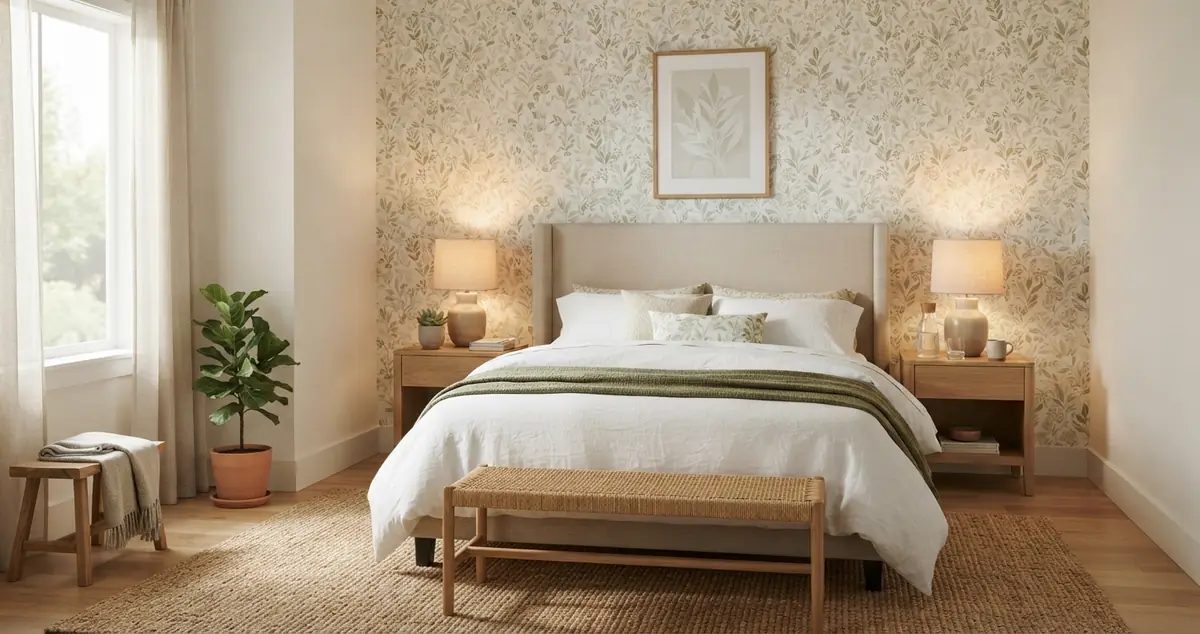
- The wall behind the bed in a bedroom. You see it when you walk in, not when you're lying down.
- The wall behind the sofa or the wall you face from the doorway in a living room.
- The wall with the fewest openings. Windows and doors cut up the pattern and add a lot of cutting work.
- A powder room, all four walls. Small spaces are where bold paper works best.
- The ceiling, if the walls are already busy with windows and art.
Avoid papering a wall that's mostly hidden by tall furniture or a big TV, since you'll barely see it. Our accent wall selector helps pick the strongest wall, and accent wall ideas has more ways to treat a single wall.
How many rolls of wallpaper do I need?
Rough numbers, so you can sanity-check a quote:
| Roll type | Typical size | Approx. coverage |
|---|---|---|
| European (metric) single roll | 20.5 in x 33 ft | about 57 sq ft |
| US single roll | 20.5-27 in wide | about 27 sq ft |
| US double roll | about 2x a single roll | about 54-56 sq ft |
Measure wall width x height, subtract large openings, then add 10 to 15 percent for waste. Add more for large repeats and drop-match patterns, since you lose more paper aligning each strip. For an exact count by wall size and repeat, use the wallpaper calculator.
Buy all rolls from the same batch (dye lot) and one extra roll for repairs.
What people on Reddit say
Wallpaper threads on r/HomeDecorating and r/interiordecorating return to the same advice:
- Get the physical sample. Colors on screen are rarely right, and the sheen or texture of the paper changes how it reads.
- Tape a large swatch up for a week. Several people order two or three samples and tape them side by side so they read as a bigger area.
- Peel-and-stick isn't a free trial. It can pull paint off when removed, and it doesn't always stick well on textured walls or in steamy bathrooms.
- One patterned wall, then decide. Many say they started with an accent wall and either loved it enough to continue or were glad they stopped.
- Busy rooms need calm paper. If the room already has patterned textiles, people recommend a tonal or textured wallpaper instead.
Is peel-and-stick wallpaper good for renters?
Peel-and-stick is the usual renter choice, but test it first. Put a small piece in a hidden spot for a week, then peel it off and check whether paint comes with it. It sticks best on smooth walls with satin or eggshell paint and poorly on flat, fresh or heavily textured walls. In bathrooms, steam can lift edges. Traditional paste-the-wall papers come off more cleanly in many cases but are harder to install yourself.
How do I see my own wallpaper on a photo of my room?
Most wallpaper visualizers only work with the retailer's own catalog. If you've already found a paper you like, from any brand, you can preview your exact pattern on your own room instead.
- Take a straight-on photo of the room in daylight, with the wall you want to paper fully in frame.
- Take or save a clear photo of the wallpaper sample, flat and evenly lit.
- Upload the room to the AI room designer and generate a first design. Keep it close to the original by adding a custom instruction like "keep the furniture, layout, windows and doors exactly the same."
- On the result, open Magic Edit, brush over the wall you want to paper, choose Replace or Custom edit, and attach your wallpaper photo as the material reference. Add an instruction such as "cover this wall with this wallpaper pattern, about a 21-inch repeat, keep the light and shadows."
- Generate up to four versions and compare them. Then try a second paper on the same photo.
AI previews are best for judging color, contrast and overall busyness at full-wall size. Pattern scale is approximate, so check the repeat against the real sample before you order. If you're deciding between wallpaper and paint, the Wall Painter lets you tap the same wall and try solid colors for comparison.
Your first design is free, with no card needed.
Frequently asked questions
Is there an app to see wallpaper on my wall?
Yes. Retailer apps show their own catalog. To preview any wallpaper, including your own sample, upload a room photo to an AI room designer and use a material reference photo of the paper on the wall you select.
Does wallpaper make a small room look smaller?
Not necessarily. Low contrast patterns and vertical stripes can make walls feel taller. Busy, high contrast patterns on every wall make small rooms feel tighter.
Should I wallpaper an accent wall or the whole room?
Start with one wall unless the room is small, like a powder room or closet, where papering every wall usually looks more deliberate.
How do I calculate how much wallpaper I need?
Measure each wall's width and height, subtract large openings, divide by the roll coverage and add 10 to 15 percent for waste, more for large pattern repeats.
Can I mix wallpaper with patterned curtains or rugs?
Yes, if the patterns differ in scale and share a color. Pair a large wallpaper pattern with a small textile pattern, or keep the textiles solid.