Exterior House Paint Visualizer: Preview Siding, Trim and Door Colors on Your Photo
About to spend thousands on exterior paint? Here's how to preview siding, trim and door colors on a photo of your own house, the 60/30/10 color rule and why exterior colors look lighter than the chip.
Hoceine
7 min read20 views
In this article
- Why aren't paint brand visualizers enough?
- How do you take a good photo of your house?
- What is the 60/30/10 rule for exterior colors?
- Why do exterior colors look lighter than the chip?
- Which exterior color combinations work for common house styles?
- How should you test exterior paint samples?
- Do you need HOA approval?
- How much does it cost to paint a house exterior?
- Preview colors on your own house
- Frequently asked questions
"Best website to visualize possible new exterior siding colors?" got more than 100 upvotes on r/homeowners. On r/ExteriorDesign, two separate threads ask for "online tools for visualizing new exterior house color" and an "app/ai tool for visualizing house paint colors."
The reason is simple: painting a house exterior is expensive, often several thousand dollars to well over ten thousand depending on size, siding and region. Nobody wants to spend that and discover the "soft sage" looks mint green from the street.
Short answer: take a straight-on photo of your house on an overcast day, then use a visualizer that lets you recolor the siding, trim and door on your own photo. Plan the scheme as roughly 60 percent body color, 30 percent trim and 10 percent accent (usually the door). Exterior colors look one or two shades lighter outdoors than on the chip, so go a little darker than you think. Confirm with large painted sample boards before you hire a painter.
Why aren't paint brand visualizers enough?
Most paint brands offer free color visualizers. They're useful for browsing, but they have limits:
- They usually only show that brand's own colors.
- Many work best on stock photos of sample houses, not your house.
- Upload tools on some sites ask you to trace surfaces by hand, which is fiddly on a full facade.
What most homeowners want is to see colors from any brand on their own house, with their own roof, brick, landscaping and neighbors' houses in view.
How do you take a good photo of your house?
The photo matters more than the tool. A bad photo gives misleading results.
- Shoot straight on. Stand across the street, centered on the house, and hold the camera level. Angled shots distort the proportions of siding and trim.
- Choose an overcast day or open shade. Harsh sun creates strong shadows and blown-out highlights that hide true color.
- Avoid early morning or sunset light. Warm golden light tints everything orange.
- Get the whole house in frame, including the roof and some landscaping, so you can judge the colors in context.
- Remove clutter if you can: cars in the driveway, bins and hoses.
If you only have a sunny or cluttered photo, the Photo fixes in the AI room designer can help. Blue sky replaces a gray or washed-out sky, and Curb appeal tidies the yard so the house is easier to judge.
What is the 60/30/10 rule for exterior colors?
A balanced exterior scheme usually uses three colors.
| Element | Share of facade | Role | Example |
|---|---|---|---|
| Body (siding) | About 60% | The main color, sets the mood | Warm white, greige, deep green, charcoal |
| Trim (windows, fascia, corners) | About 30% | Frames the house, adds contrast | White, cream, black, or a shade darker than the body |
| Accent (front door, shutters) | About 10% | Draws the eye to the entry | Black, navy, red, ochre, natural wood |
Your roof, brick and stone act like fixed colors in this scheme. Choose body, trim and accent colors that work with them. Our front door color guide has pairings for common siding colors.
Why do exterior colors look lighter than the chip?
Daylight outdoors is much brighter than indoor light, and large surfaces reflect more of it. The result is that exterior colors usually look a shade or two lighter and less saturated on the house than on a small chip. A pale gray-green can read almost white, and a muted blue can look bright.
Practical rules:
- Choose a color one or two steps darker on the paint strip than the one you think you want.
- Be careful with very saturated colors on large areas. They intensify on a big wall.
- Look at the colors next to your roof. A cool roof and warm siding (or the reverse) can clash.
Which exterior color combinations work for common house styles?
House style narrows the choice before you even open a fan deck. These directions are common starting points, not rules.
- Ranch and mid-century homes: warm whites, soft greige or deep green body, with wood or bold accent doors in mustard, teal or orange-red.
- Colonial and traditional two-story homes: white, cream, soft gray or navy body with crisp white trim and black or red doors and shutters.
- Craftsman bungalows: earthy greens, browns and warm grays, with cream or contrasting trim and a stained wood door.
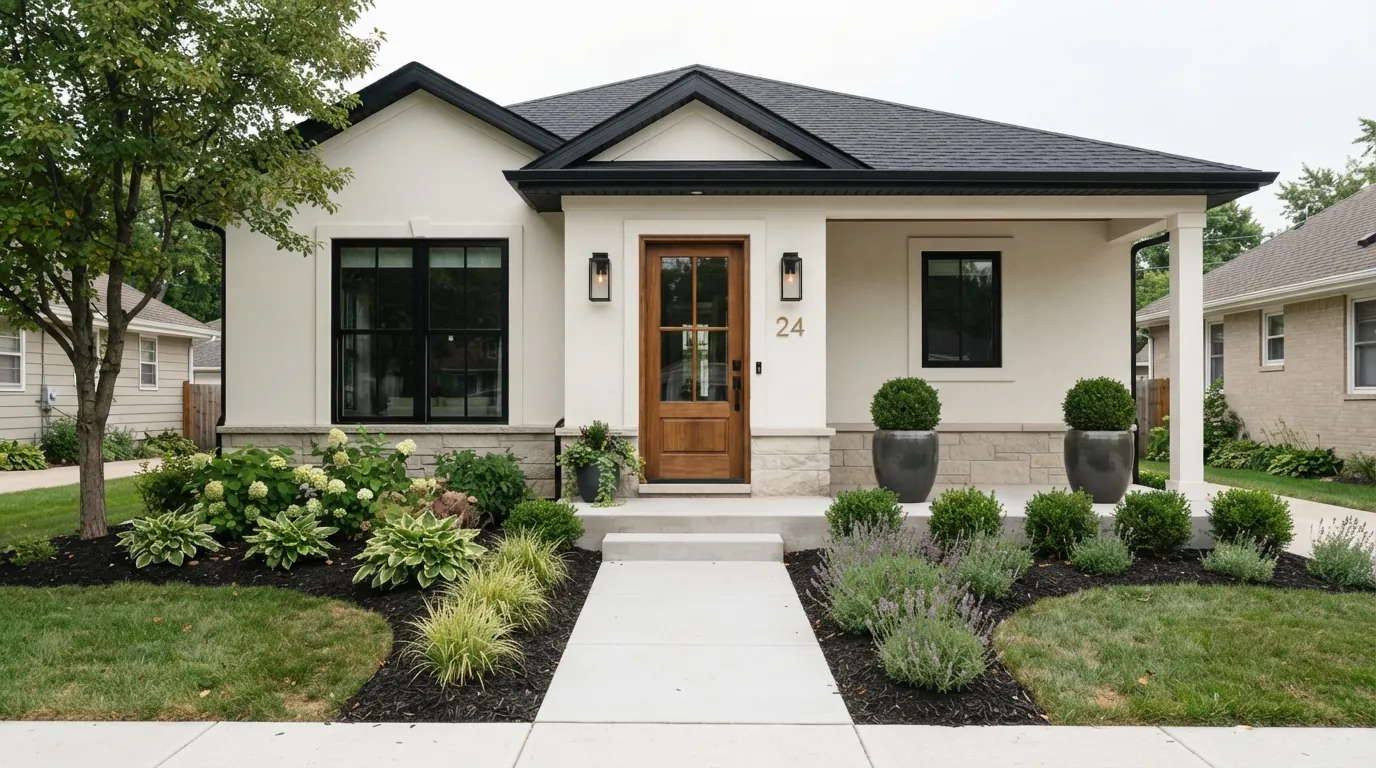
- Modern farmhouse: white or very light body with black windows and trim, plus natural wood accents.
- Contemporary homes: charcoal, black or deep green body with minimal trim contrast, mixed with wood or metal cladding.
Whatever the style, keep the scheme to three main colors plus your roof and masonry.
How should you test exterior paint samples?
A visualizer narrows the options. Physical samples confirm them.
- Paint sample boards at least 2 x 3 feet. Small swatches are almost useless outdoors.
- Put two or three boards against different sides of the house, including a sunny side and a shaded side.
- Look at them morning, midday and evening, from the street as well as up close.
- Check them against the trim color and the roof.
Do you need HOA approval?
Many homeowners associations require approval for exterior color changes, and some limit choices to an approved palette. Check your HOA rules before spending money on samples. Historic districts may have similar rules. A visualizer image of your actual house is often helpful when submitting a color request.
How much does it cost to paint a house exterior?
Costs vary with house size, siding material, number of stories, prep needs and region. For many homes in the US, professional exterior painting costs from a few thousand dollars to well over $10,000 for larger or more detailed houses. The house painting cost calculator gives an estimate for your size and siding type.
Preview colors on your own house
Upload a straight-on photo of your house to the Wall Painter. Tap the siding and choose a body color, then try trim and door colors. Compare a few complete schemes on the same photo so you can see which one fits your roof and landscaping.
For more than color, open the photo in the AI room designer. Use Magic Edit to brush over the front door or shutters and get up to four options, then apply Photo fixes like Curb appeal, Landscaping or Green lawn to see the house at its best. If you're preparing a listing, Day to dusk turns a daytime photo into a twilight shot with warm glowing windows. New accounts get free credits to test it on your own home.
For more about choosing colors with AI, see our AI room painter guide.
Frequently asked questions
Is there an app to see what color my house would look like?
Yes. AI visualizers let you upload a photo of your house and recolor the siding, trim and door. Look for one that works on your own photo with any color, not only a single brand's fan deck.
How do I choose exterior paint colors for my house?
Start with fixed elements like the roof, brick and stone. Then pick a body color, a trim color and an accent color in roughly 60/30/10 proportions, and test large samples on the house.
Do exterior paint colors look lighter or darker on the house?
Usually lighter and less saturated, because outdoor light is much brighter. Choose a shade or two darker than the chip you like.
Should trim be lighter or darker than siding?
Either works. Light trim on darker siding looks classic and crisp. Dark trim on light siding looks modern. Low contrast between them gives a quieter look.