Why Your Room Feels Empty (Even After Decorating): a 10-Point Diagnostic
You bought the sofa, the rug and the art, and the room still feels cold. Walk through these 10 checks to find what's missing, with the numbers to fix each one.
Hoceine
9 min read14 views
In this article
- The 10-point diagnostic
- Is your rug too small?
- Do you have curtains, and are they hung right?
- Is all your light coming from the ceiling?
- Is your furniture pushed against the walls?
- Is your art too small?
- Is everything smooth and the same color?
- Is there anything green?
- Is everything below knee height?
- Are your corners bare?
- How to see the fixes before you buy
- Frequently asked questions
A post on r/HomeDecorating with almost 500 upvotes said it plainly: "My living room doesn't feel cozy or homey." Another one, titled "I think our living room is done, but it feels very cold," showed a room with a nice sofa, a TV, a rug and a couple of frames. Nothing was wrong with any single piece. The room still looked like a furniture showroom after closing time.
This happens to almost everyone, and the cause is usually a short list of fixable problems.
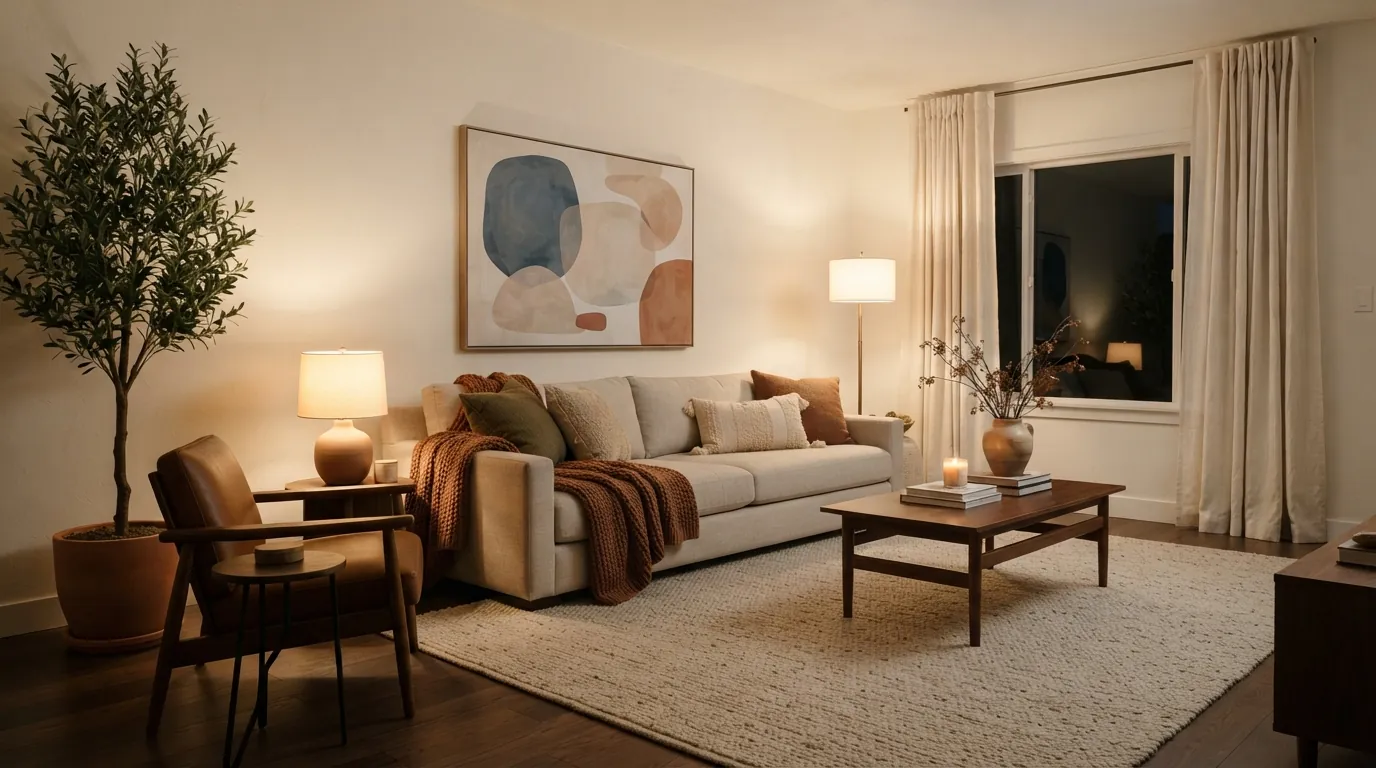
Short answer: a room feels empty when the pieces are too small for the space, the light comes from one overhead fixture, and every surface is smooth and the same tone. Check rug size (front sofa legs on it), add at least three lamps with 2700K bulbs, hang curtains high and wide, pull furniture off the walls, and add texture, plants and something at eye level.
The 10-point diagnostic
Go through your room with a tape measure and this list. Most "cold" rooms fail three or four of these.
| # | Check | Passes if... | Common fail |
|---|---|---|---|
| 1 | Rug size | At least the front legs of every seat sit on it | 5x7 rug floating in front of the sofa |
| 2 | Curtains | Rod 4-6 in above the window frame, panels touching the floor | No curtains, or rod sitting on the trim |
| 3 | Lighting | 3+ light sources at different heights, 2700K bulbs | One ceiling light at 4000K or 5000K |
| 4 | Furniture placement | Seating grouped, sofa pulled at least a few inches off the wall | Everything pushed to the edges |
| 5 | Art scale | Art is about 2/3 the width of the furniture below it | Small frames floating on big walls |
| 6 | Texture | At least 3 different materials you can feel | All smooth: leather, glass, flat cotton |
| 7 | Tone | A mix of light, mid and dark values | Everything white, gray or the same beige |
| 8 | Living things | One or more plants, real or good-quality faux | Nothing green anywhere |
| 9 | Eye-level interest | Something between 4 and 6 ft high on most walls | All decor below 3 ft |
| 10 | Corners | Each corner holds a lamp, plant, chair or shelf | Bare corners |
Now the details on each one.
Is your rug too small?
This is the most common problem on every "my room feels empty" thread. A small rug makes the furniture look like it's floating, and the bare floor around it adds to the cold feeling.
In a living room, aim for a rug large enough that the front legs of the sofa and every chair rest on it. For a standard 84-inch sofa, that usually means 8x10 or bigger. A 5x7 almost always reads as too small unless the room itself is tiny. Leave about 8 to 18 inches of bare floor between the rug and the walls.
Our rug size calculator gives you the size from your room and sofa dimensions, and the rug size guide covers layouts for living rooms, bedrooms and dining rooms.
Do you have curtains, and are they hung right?
Bare windows make a room echo, visually and literally. Fabric softens the hard edges of the window frame and absorbs some sound.
Hang the rod 4 to 6 inches above the window frame, or halfway between the frame and the ceiling if you have the room. Extend it 8 to 12 inches past each side so the panels stack on the wall instead of covering glass. Panels should touch the floor or "kiss" it. Curtains that stop above the floor make a room look shorter and a little unfinished.
The curtain rod length calculator and curtain length calculator handle the math.
Is all your light coming from the ceiling?
One overhead fixture lights the floor and the tops of heads, and leaves the walls and corners dim. That flat, even light is a big part of why a room feels like an office.
Interior designers talk about layered lighting: ambient (ceiling), task (reading lamps) and accent (lamps or sconces that light walls and objects). In practice, a living room usually needs:
- A floor lamp next to the sofa or reading chair
- One or two table lamps on side tables or a console
- Something lighting a wall or corner: an uplight behind a plant, a picture light, or a plug-in sconce
Bulb color matters as much as the number of lamps. Look at the box: 2700K is warm white and reads as cozy in the evening. 3000K is slightly crisper. 4000K and 5000K are cool and belong in garages and offices. The light color temperature calculator and the lighting calculator help you figure out how much light the room needs and in what color.
At night, try turning the ceiling light off completely and running only lamps. If the room suddenly feels better, you've found your problem.
Is your furniture pushed against the walls?
People push everything to the edges to "make space." The result is a big empty middle and seats that are too far apart to talk across.
Pull the sofa off the wall, even 6 inches helps, and bring chairs in so seats face each other. A conversation area works best when seats are within about 8 to 10 feet of each other. Keep 16 to 18 inches between the sofa and the coffee table and about 36 inches for main walkways. The furniture clearance calculator checks your numbers, and our guide on how to arrange living room furniture has layouts for common room shapes.
Is your art too small?
A 16x20 frame on a 12-foot wall looks lost. Art over a sofa or console should be about two-thirds the width of the furniture beneath it. Over an 84-inch sofa, that's a piece (or a group) around 56 inches wide. The art above couch guide has a full size chart.
If you already own small pieces you love, group them into one larger arrangement with 2 to 3 inches between frames, or put each one in a large frame with a wide mat.
Is everything smooth and the same color?
A room can have all the right pieces and still feel flat if every surface reflects light the same way. Texture is what makes a room look warm in photos and in person.
Aim for a mix you can feel with your hand:
- Wool or a chunky knit throw
- Linen or cotton slub on pillows and curtains
- Wood with visible grain on a coffee table, frame or stool
- Something woven: a jute rug, rattan basket or cane chair
- A little metal or ceramic for contrast
The same goes for tone. A room that's all light gray or all beige needs a few darker anchors: a walnut side table, black picture frames, a deep green or rust pillow. Interior designers often talk about the 60-30-10 split (a dominant color, a secondary color and an accent), and a cold room usually only has the 60.
Pillows are the cheapest place to start. The throw pillow calculator tells you how many and what sizes fit your sofa.
Is there anything green?
A single plant changes how a room photographs and feels. A fiddle leaf fig, olive tree, rubber plant or tall snake plant in a corner fills vertical space that furniture can't. If your light is poor or you travel a lot, a good faux plant is fine. Choose one with some variation in leaf color so it doesn't look plastic.
Is everything below knee height?
Look at your walls from the sofa. If the only things above 3 feet are a TV and a ceiling light, the room feels bottom-heavy and empty up top. Tall lamps, shelves, curtains hung high, mirrors and art at eye level (the center of a piece around 57 to 60 inches from the floor on an open wall) all pull the eye upward.
Are your corners bare?
Bare corners make the walls look longer and the room bigger in a bad way. Each corner should hold something: a floor lamp, a tall plant, an accent chair with a small side table, or a narrow bookshelf. Corners are also the easiest place to add light, since a lamp there bounces off two walls.
How to see the fixes before you buy
If you're not sure which of these your room needs most, take a photo from the doorway and upload it to the AI room designer. You can ask for a warmer version of the same room: bigger rug, more lamps, layered textiles, plants in the corners. Since it starts from your real photo, the walls, windows and floor stay where they are, and you see how much each change helps before you spend anything. New accounts get free credits to try it.
If you want to test a specific item, Magic Edit lets you brush over an area, like a bare corner or a too-small rug, and replace it, with up to four options to compare side by side.
For more warmth-focused ideas, our cozy living room guide goes deeper on materials and lighting.
Frequently asked questions
Why does my living room feel cold even with furniture?
Usually because of light and texture. A single overhead light at a cool color temperature, plus smooth materials and one dominant color, makes a furnished room feel cold. Add lamps with 2700K bulbs, a wool or jute rug, linen curtains and some wood.
How do I make a room feel less empty without buying more furniture?
Rearrange first. Pull furniture off the walls into a tighter group, hang curtains higher, move art to eye level and switch to warm bulbs. Then add soft items like pillows, throws and plants, which cost much less than furniture.
How many lamps should a living room have?
Most living rooms feel best with three to five light sources at different heights, not counting the ceiling fixture. A floor lamp, two table lamps and one accent light is a good starting point.
What size rug makes a room feel finished?
One large enough that at least the front legs of all the seating rest on it. In most living rooms that's 8x10 or 9x12. A rug that only fits under the coffee table usually makes the room look emptier.