Paint a Brick Fireplace or Not? 6 Options From Limewash to Full Paint
Hate the brick but scared to paint it? Here are six options ranked from most to least reversible, the colors that work, heat rules for the firebox and how to style the mantel.
Hoceine
7 min read16 views
In this article
The title of one popular r/HomeDecorating thread says it all: "Team Don't Paint the Brick…but what do I do?" It got hundreds of upvotes, and the comments split the way they always do on this topic. Some people think painting brick is a crime. Others have painted theirs and never looked back.
Both sides have a point. Painted brick is very hard to undo, but an orange or patchy brick fireplace can dominate a room in a way you don't like. The good news is that full paint isn't the only option.
Short answer: painting brick is effectively permanent, because stripping it later is slow, messy and can cost $1,000 or more. If you're unsure, start with reversible or semi-reversible options: deep cleaning, restyling the mantel, limewash or a German smear. If you do paint, use a breathable masonry or mineral paint on the surround, and only high-heat paint inside the firebox.
Why is painted brick so hard to undo?
Brick is porous. Paint soaks into the surface and the mortar joints, so it doesn't peel off cleanly. Removing it usually means chemical strippers applied in several rounds, scrubbing every mortar joint and sometimes leaving a faint residue anyway. Many homeowners end up hiring a professional, and the job can easily cost $1,000 or more for a typical fireplace.
That's why it's worth trying lighter options first.
What are your options, from most to least reversible?
| Option | Reversible? | Look | Effort |
|---|---|---|---|
| 1. Clean the brick | Fully | Same brick, brighter and less sooty | Low |
| 2. Restyle the mantel and surroundings | Fully | Brick stays, the room changes around it | Low |
| 3. Limewash | Partly (can be washed back while fresh) | Soft, chalky, aged look, brick shows through | Low to medium |
| 4. Whitewash | Mostly not | Thinned paint, brick texture visible | Medium |
| 5. German smear | No | Mortar spread over brick, old European look | Medium to high |
| 6. Mineral or masonry paint | No | Solid color, brick texture shows | Medium |
1. Clean the brick
Soot and decades of grime darken brick and make it look worse than it is. Scrub it with a stiff brush and a masonry cleaner or a TSP solution, following the label and protecting the floor. Many people are surprised how much the color changes once it's clean.
2. Restyle around it
Sometimes the brick isn't the problem; the surroundings are. Try:
- Painting the walls around the fireplace a color that complements the brick. Warm whites, soft greens and deep charcoals all work with red brick.
- Adding a new wood mantel shelf, which breaks up a large brick wall.
- Hanging large art or a mirror above the mantel.
- Using a large rug in front with colors that tone down the orange.
3. Limewash
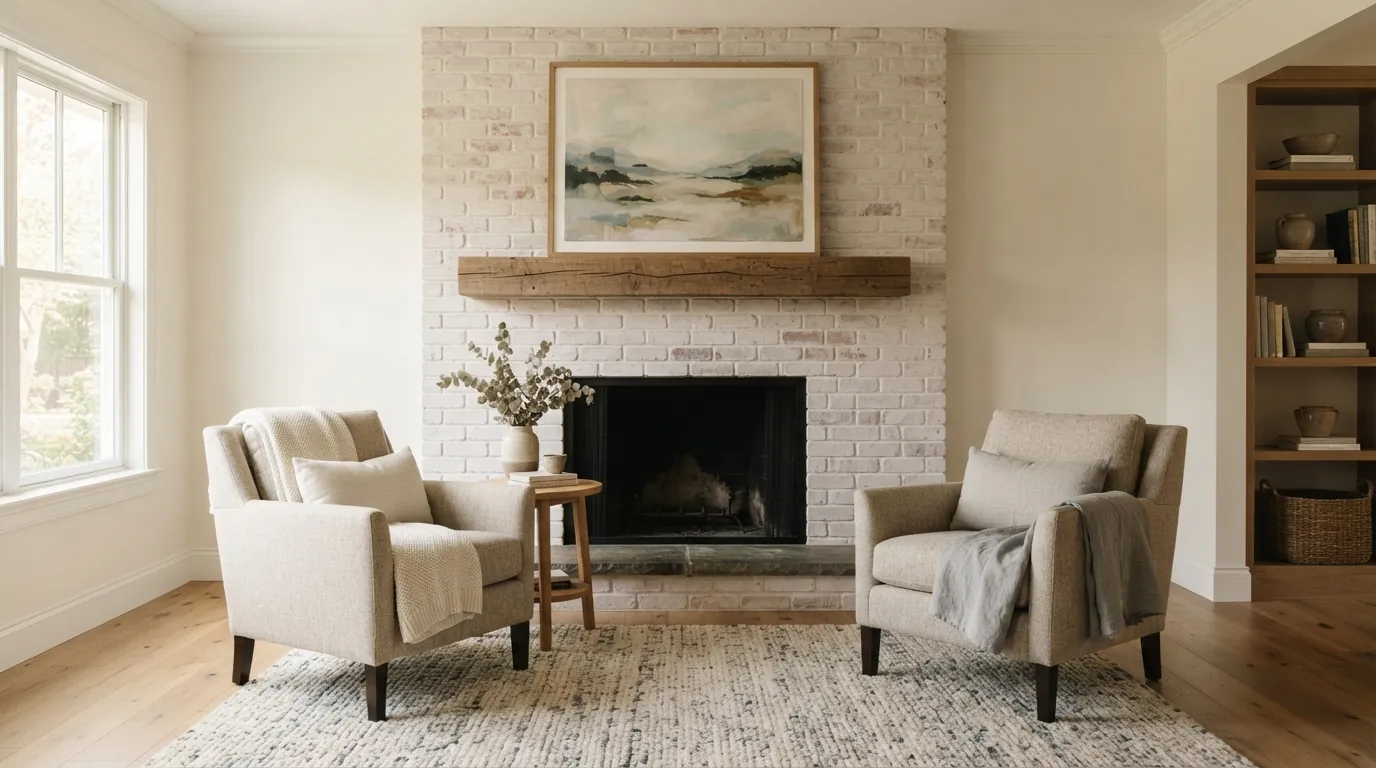
Limewash is a mineral coating made from slaked lime. It soaks into brick instead of sitting on top of it, giving a soft, chalky, slightly uneven finish where the brick still shows through. While it's fresh, you can wash some of it back with water to get the look you want. Over years, it naturally weathers and fades, which some people like and others don't. It only works on unsealed, unpainted brick.
4. Whitewash
Whitewash is usually latex paint thinned with water, brushed on and wiped back. It's similar in look to limewash but harder to remove, because it's still paint.
5. German smear
A German smear (or "mortar wash") means spreading wet mortar over the brick and partly wiping it off, leaving brick showing in places. It looks like an old European cottage wall. Because it's mortar, it's permanent.
6. Paint
If you're sure, use a breathable masonry paint or a mineral (silicate) paint for the brick surround. These let moisture escape from the brick instead of trapping it, which reduces peeling. Clean the brick first, let it dry completely and use a masonry primer if the paint calls for one.
What about the inside of the firebox?
The firebox (the inside where the fire burns) gets far hotter than the surround. Regular wall paint will blister or burn there. If you want to paint inside the firebox, use high-heat paint rated for that use, usually in black. Many people leave the firebox alone and paint only the surround. Check your fireplace or insert manufacturer's guidance, especially for gas inserts.
Also keep combustible decor such as garlands, baskets and wood bowls away from the opening. Our fireplace hearth clearance calculator helps check common clearance guidelines, though your local code and the fireplace manufacturer have the final say.
What color should you paint a brick fireplace?
Four directions work for most rooms:
- Warm white or cream. Bright and fresh. Sherwin-Williams Alabaster and Benjamin Moore White Dove are popular because they avoid the stark, blue look of pure white.
- Greige or warm gray. A softer neutral that hides soot marks better than white.
- Charcoal or near black. Dramatic and modern. Sherwin-Williams Iron Ore and Tricorn Black are common picks. Dark colors also hide soot well.
- The wall color. Painting the fireplace the same color as the walls makes it blend in, which is a good choice in small rooms or when the fireplace sits off-center.
How should you style the mantel?
A painted or refreshed fireplace still needs a well-scaled mantel.
- Mantel depth: about 8 to 12 inches holds art, a mirror or a few objects without looking flimsy.
- Mantel length: often a few inches wider than the firebox opening on each side, or the full width of the surround.
- Art or mirror above: roughly two-thirds to three-quarters of the mantel width. Hang it a few inches above the mantel shelf, not halfway up the wall.
Use the fireplace mantel calculator for mantel sizing and the art size calculator for the piece above it. The sizing logic in what size art goes above a couch applies to mantels too.
See it before you commit
Since paint is the one choice you can't easily undo, it's worth seeing it first. Take a photo of the fireplace wall and open it in the Wall Painter. Select the brick surround, try warm white, greige and charcoal, and compare them with your real floors and furniture.
To test other looks such as limewash, German smear or a new mantel, upload the photo to the AI room designer and use Magic Edit. Brush over the fireplace and describe the finish you want. You'll get up to four versions to compare. New accounts get free credits, so you can try it on your own fireplace.
For more ways to make one wall the focal point, see our accent wall ideas.
Frequently asked questions
Should I paint my brick fireplace?
Paint it if you're sure you'll never want exposed brick again. If you're unsure, try cleaning, restyling or limewash first, since painted brick is very hard and expensive to strip.
Is limewash better than paint for brick?
Limewash is more forgiving. It soaks into the brick, lets it breathe, can be partly washed back while fresh and gives a soft aged look. Paint gives solid, permanent color.
What paint do you use on a brick fireplace?
Use a breathable masonry or mineral paint on the surround and high-heat paint inside the firebox. Clean the brick and let it dry completely first.
What color should I paint my brick fireplace?
Warm white, greige, charcoal or the same color as the walls. Warm whites brighten the room, charcoal adds drama and hides soot, and the wall color helps the fireplace blend in.