How to Choose a Kitchen Backsplash That Goes With Your Countertop
Holding three tile samples against your counter and still can't decide? Here's the order to choose in, how to match busy and quiet surfaces, grout color, height and layout.
Hoceine
7 min read17 views
In this article
- What order should you choose kitchen finishes in?
- The busy-quiet rule
- Which tile materials are common for backsplashes?
- What color grout should you use?
- How high should a backsplash go?
- Which layout should you choose?
- How much does a backsplash cost?
- How to see the backsplash in your own kitchen
- Frequently asked questions
On r/kitchenremodel, "Which backsplash tile?" posts follow a pattern: a photo of a new quartz or granite counter, three or four tile samples leaning against the wall, and a question about which one works. Someone in another thread asked, "Is there any good tile/backsplash visualizer?" because a 4-inch sample tells you very little about how 30 square feet of it will look.
Here is a way to narrow it down that doesn't depend on taste alone.
Short answer: choose the countertop first, then pick a backsplash that balances it. A busy counter (veined quartz, patterned granite) needs a quiet tile in a solid color pulled from the stone. A plain counter can handle zellige, pattern or a bold color. Match the grout for a calm look, contrast it for a graphic one, and run the tile to the ceiling behind a range or open shelving.
What order should you choose kitchen finishes in?
The usual order is countertop, then backsplash, then wall paint. Paint comes last because it's the cheapest to change and comes in thousands of colors. Countertops come first because slabs have the fewest options and the most variation from one to the next.
If you're keeping existing counters, they are your starting point by default. Bring a sample or a photo of the counter in daylight when you shop for tile, and hold tile samples flat on the counter and upright against the wall, since the same tile looks different in each position.
The busy-quiet rule
This one idea answers most "which tile?" questions.
| Your countertop | Backsplash that usually works | What to avoid |
|---|---|---|
| Heavily veined quartz or marble (Calacatta style) | Plain white or cream tile, or a slab of the same stone | Patterned or multicolor tile |
| Speckled or patterned granite | Solid tile in one color pulled from the granite | Another busy stone, small mixed mosaics |
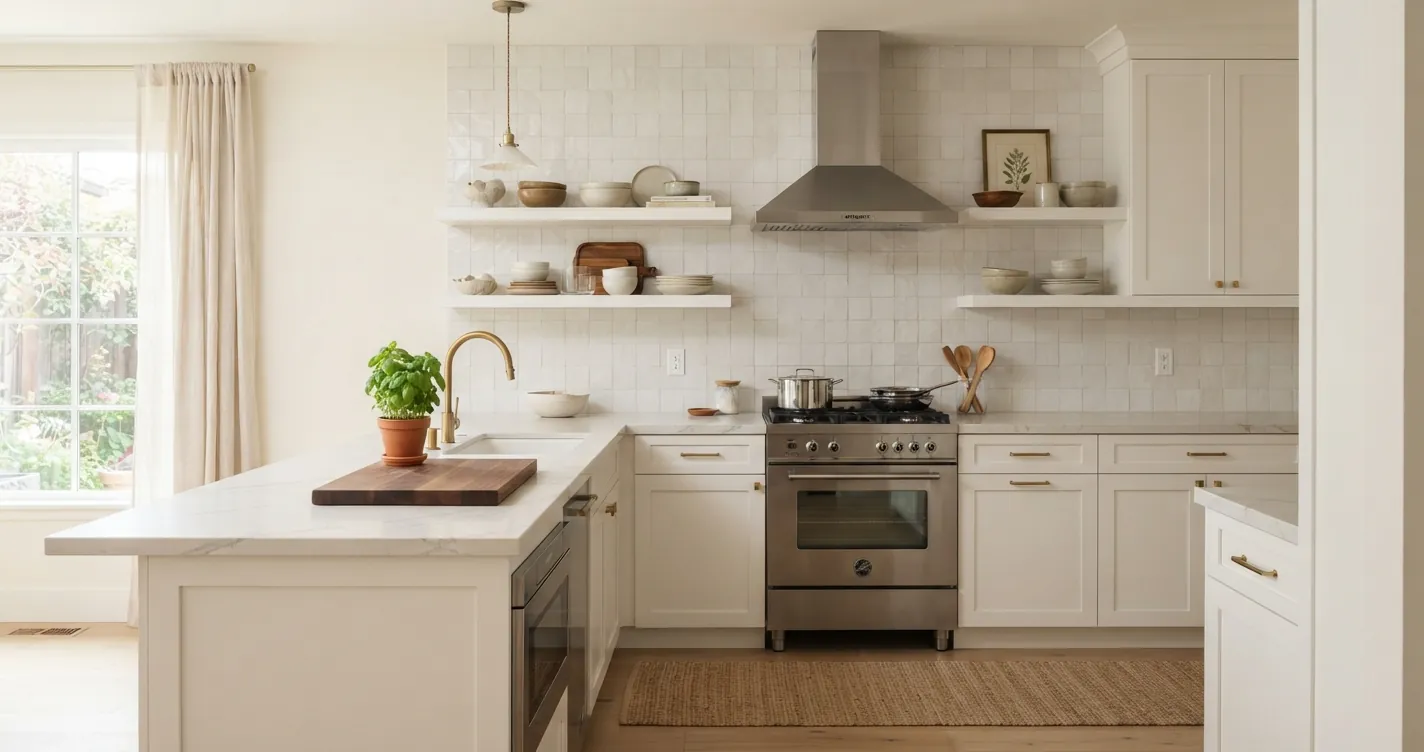
| Solid white or light quartz | Zellige, colored subway, patterned cement-look, vertical stack | Very similar flat white (can look unfinished) |
| Butcher block or wood | Cream, green or blue tile, handmade-look ceramic | Busy patterns that fight the wood grain |
| Dark solid (black, charcoal) | Light, textured tile for contrast | Dark tile that turns the wall into a cave |
| Laminate | Simple ceramic subway in a color from the laminate | Expensive stone mosaics that make the laminate look cheaper |
The reasoning is simple. Two busy surfaces right next to each other compete, and the kitchen looks cluttered even when it's empty. One busy surface and one quiet one gives the eye somewhere to rest.
When you pull a color from a speckled granite, pick one of the minor colors, not the dominant one. A tan granite with gray and black flecks often looks better with a soft gray tile than a tan one, because the tile then picks up the stone's detail rather than blending into it.
Which tile materials are common for backsplashes?
- Ceramic subway tile (3x6 is the classic size, 2.5x8 and 3x12 are common alternatives): affordable, easy to clean, works almost anywhere.
- Zellige and handmade-look tile: glazed with uneven surfaces and edges, so it catches light and looks warm. Real Moroccan zellige varies a lot from tile to tile and needs sealing. Porcelain and ceramic "zellige-look" tiles are more uniform and cheaper.
- Porcelain: dense and stain resistant, often printed to look like marble or concrete.
- Natural stone mosaics: marble and travertine look great but need sealing, and marble etches from acidic splashes like lemon juice and vinegar.
- Slab backsplash: the same quartz or stone as the counter carried up the wall. No grout lines, very clean, more expensive.
- Glass tile: reflective and easy to wipe, but cut edges need careful finishing.
What color grout should you use?
Grout changes how the tile reads more than most people expect.
- Matching grout (white tile, white or off-white grout) blurs the lines and makes the wall look calm and solid.
- Contrasting grout (white tile, charcoal grout) shows off the layout and reads graphic and more traditional.
- A grout one shade darker than the tile is a common middle ground that hides some staining without drawing lines all over the wall.
Avoid bright white grout behind the stove. Cooking splatter and grease stain it fast, and cementitious grout is porous. If you want white there, consider epoxy grout, which resists stains much better but is harder to install. Sealing regular cement grout helps too.
The grout calculator estimates how much you need from tile size, joint width and area.
How high should a backsplash go?
The standard distance between a counter and upper cabinets is 18 inches, and a standard backsplash fills that gap.
A few situations call for more:
- Behind a range with a hood: many people take the tile to the hood or all the way to the ceiling. It's easier to clean and turns the range wall into the focal point.
- Open shelves instead of uppers: run the tile to the ceiling, or at least well above the top shelf, so the wall doesn't stop at an odd height.
- Windows: stop the tile at the window trim or wrap it into the window return.
Where to stop sideways is the other question. The cleanest place is usually the outer edge of the upper cabinets, or a natural break like a wall corner. Finish exposed tile edges with bullnose pieces or a metal edge trim.
Which layout should you choose?
| Layout | Look | Extra tile to order |
|---|---|---|
| Offset (running bond) | Classic, familiar | About 10% |
| Stacked horizontal | Modern, clean | About 10% |
| Stacked vertical | Taller-looking wall, modern | About 10% |
| Herringbone | Busy, high-movement | About 15-20% |
| Chevron | Similar to herringbone, needs angled tile | About 15-20% |
Herringbone and diagonal layouts waste more tile because of all the angled cuts at the edges. They also take longer to install, which raises labor cost. On a busy granite, a herringbone backsplash is usually one pattern too many.
How much does a backsplash cost?
Installed costs vary a lot by region and tile, but a common range is roughly $10 to $50 per square foot, with basic ceramic subway at the low end and handmade, stone or intricate mosaic at the high end. A typical backsplash is 25 to 40 square feet, so the tile choice often matters less to the total than labor and layout.
Use the backsplash calculator to get your square footage with outlets and windows subtracted, and the tile calculator for box counts with waste.
How to see the backsplash in your own kitchen
Samples are useful for color, and nearly useless for judging how a whole wall of a pattern looks. Before you order, take a straight-on photo of your kitchen and open it in the AI room designer. Use Magic Edit to brush over the backsplash area and describe the tile you're considering, for example "white zellige, matching grout" or "3x12 sage green stacked vertical". You can request up to four versions at once and swipe between them, so your three samples become three full walls you can compare with your actual counters and cabinets. New accounts get free credits to try it.
If you're refreshing the whole kitchen on a budget, our budget kitchen design guide covers what else to change around a new backsplash.
Frequently asked questions
Should the backsplash be lighter or darker than the countertop?
Either works if there's enough contrast. Most kitchens use a backsplash slightly lighter than the counter, which keeps the wall bright. A darker backsplash works best with light counters and plenty of daylight.
Should a backsplash match the countertop or the cabinets?
Pull the color from the countertop and the overall tone from the cabinets. With white cabinets and veined quartz, a white or cream tile that matches the stone's background works. With wood or colored cabinets, a neutral tile keeps the cabinets as the star.
Is subway tile outdated?
Classic white 3x6 subway has been popular for over a century and is still common. If you want something less expected, change the size (2x8, 3x12), the layout (stacked vertical) or the finish (handmade or zellige-look) while keeping the simple shape.
What color grout hides dirt best?
A mid-tone gray or a grout one or two shades darker than the tile hides stains best. Avoid bright white grout near the stove and sink.